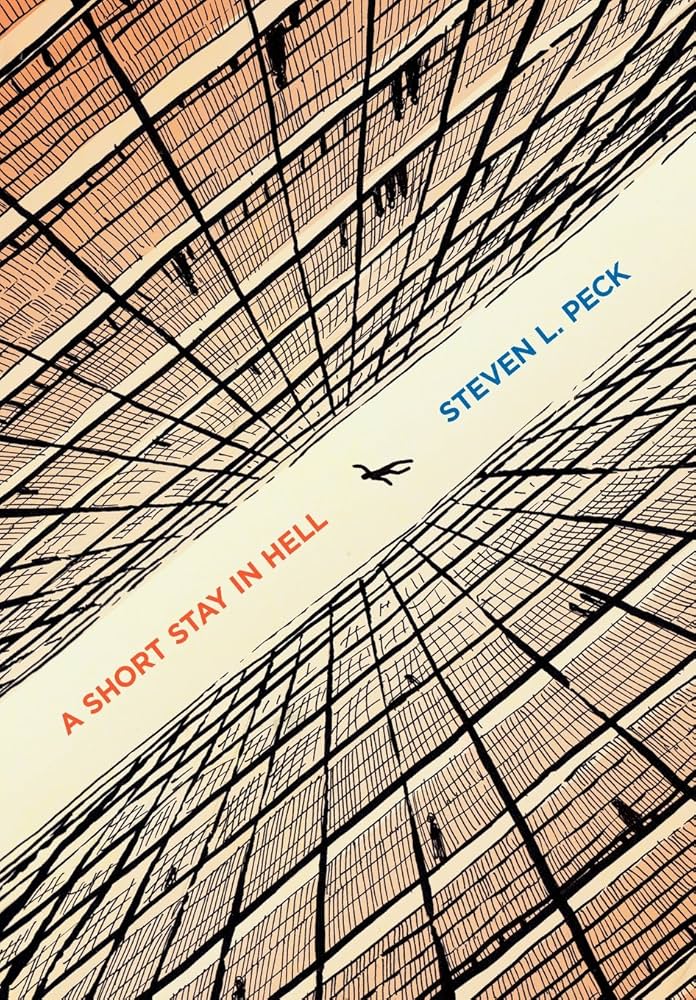
PREMISE: A guy dies and finds himself in Hell. That’s all you’re getting.
I flew through this. And not just because it’s only just over 100 pages long. It’s fantastic and addictively written and definitely makes you think. Not about Hell; personally I’m fairly convinced Hell doesn’t exist and if it does (and therefore Heaven also) then man, did I back the wrong Horse of Life. I’ve got no beef with people who do think they both exist, however. In fact, if Hell is actually waiting for me then I’ll be pretty happy if it’s an infinitely huge library. Even if it does mean I spend eternity looking for American Tabloid.
I’m not dipping into Goodreads for this one but fair to say I’ve had a look and there’s the usual handful of bellends and, staggeringly, a bunch of people who didn’t even finish this. It’s 100 pages! How fucking lazy are some people?
In case you haven’t realised, I’m not an academic book reader / reviewer. I don’t notice if a book is using a particular kind of technique or is espousing some deep shit philosophy or even whether the author’s intention is to make some sort of statement or comment on something. If it’s a well-written book with a good premise and story and – crucially – it entertains me or moves me or makes me think then that’s exactly what I’m looking for in a book. Just like this one.
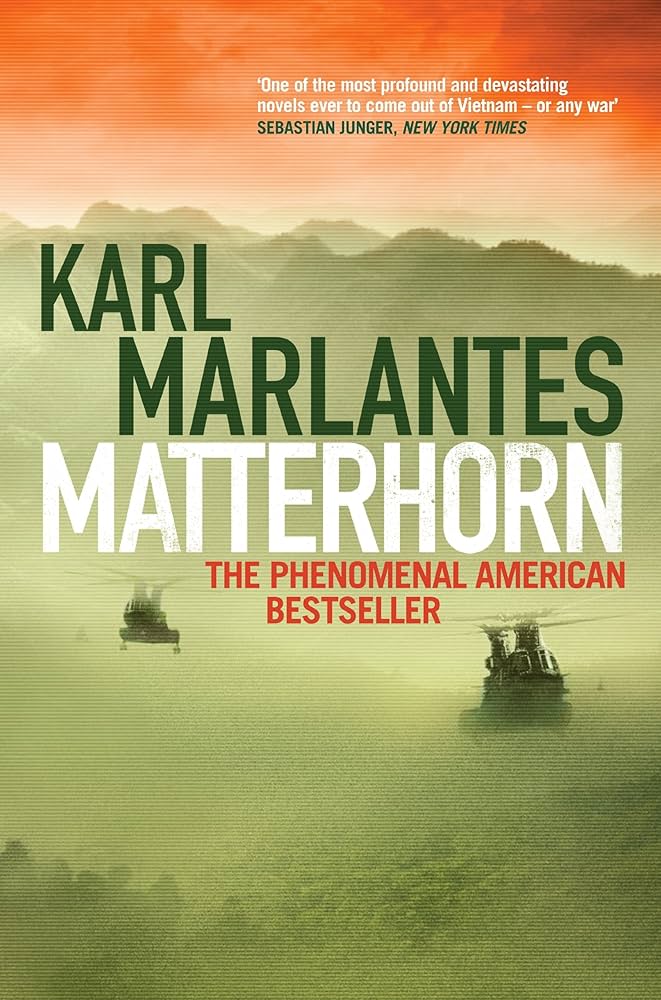
PREMISE: Following a soldier during his time in the Vietnam war.
Yeaaaaaah…I kept that premise short and sweet so we can get to the juicy stuff. Before we visit Goodreads Island, where twats, bellends and utter nob-jockeys live in sweet harmony, let me start by saying this book is amazing. I first read it a fair few years ago and it’s just as good the second time around. Nothing explains what it’s like to be a soldier – and in this case, in a completely pointless and fucked up war – like this. It’s written as a fictional story but it’s essentially true. It’s long and detailed and all-encompassing and addictive and unlike any other book involving conflict that I’ve ever read. Cannot recommend it enough.
And I cannot recommend enough having a browse of the Goodreads 1-starrers for this baby. They really are on another level. And, perhaps more so than any other book I’ve ‘researched’ (hehehe…I laughed at that term too) it exemplifies why the 1-star ratings are absolute horseshit.
As at writing, there are 976 1-star reviews of Matterhorn. Of the first 45 that appeared on my screen, 21 admitted to not having even finished it. Using a complex system of mathematical extrapolation, I make this almost 50% of reviewers who rated this book 1 out of 5 haven’t even finished it. What is the point of them leaving a ‘so-called’ review? It’s not a review as they’ve ultimately nothing to review…because they haven’t read it. Similarly, how can they give a rating to something they haven’t finished? That’s like me baking a cake and someone rating me on how good it is while I’m still in the mixing stage. For some reason that I can’t fathom, it annoys the shit out of me.
And at the same time, I’m glad they choose to write something as I get to ridicule them here. If they’re at liberty to write shit about a book they haven’t even had the decency to finish reading then I’m at liberty to take the piss and call them names. Just like adults should.
I’m starting with the (frankly unbelievable) ‘review’ by Rebecca Curtis, where she admits “I did not actually read this”. Yep, you read that right. WTF? She writes a couple of lines and gives a 1-star rating to a book that she hasn’t even read. RC, you are a moron. Several people commented that they either hate war (who doesn’t?) or hate war books. Or both. Which begs the question, why are they even contemplating reading this then? Sado-masochists of the world unite. Surely they’ll have more fun just flogging themselves or running their genitals over a cheese grater? A couple of people commented on the bad language, like that is the worst thing that Marlantes could have included. Forget the violence, genocide, brutality, utter devastation and the lasting effects that this war – any war, really – has on people…the language that was involved was just too much. It’s okay for soldiers to shoot each other in the face, but absolutely unacceptable to accompany that with a swear word. “Take that, you brute”…”Oooh, you nasty rotter, you shot me in the goolies”…”Excuse me, my good man, why are you hacking my arm off with a machete?”. All of these would have been much more acceptable and, dare I say it, realistic? Come on Marlantes, what the fuck is wrong with you and your potty mouth?
One of my favourites comes from Marco3x (3 times as big a bellend): “This is garbage. The author has watched too many war movies”. Karl Marlantes is a Vietnam veteran. He was there. As opposed to Marco3x, who, judging by his picture, wasn’t. Another was from Mark, who read between 1/3 and 1/2 (two fifths would have worked there Mark) and then “found out it was just going to be another “wow, this war in Vietnam really sucks” book and returned it”. He’s got a point; where are all the positive books that don’t focus on the death and violence but talk about how well the helicopters performed? Or how much money was made by people who had shares in bullet-making companies? Or how many annoying weeds were destroyed by napalm?
Weirdly, the one that has me scratching my head (and simultaneously pulling my hair out) the most is this doozy by Heather Doherty: “I couldn’t read it. War sucks”. I may be wrong on this, but I don’t think Karl Marlantes is to blame for the Vietnam war. And Heather dear, what you’re actually rating with your 1 star is war itself, not this novel. And if this is the case, why are you even giving war 1 star? Surely every war is a no-star affair? And you didn’t even read it. So, what you’ve done is saddled Marlantes with a 1-star rating for a book you didn’t even read because (and rightly so) you think war sucks. How is this the author’s fault? And have you done this for every other fictional war book out there? It seems only fair.
So, once again I’m back to my contradictive point; you shouldn’t be allowed to rate a book you haven’t finished (and certainly not one you haven’t even read!). However, I’m glad that it is allowed, as it gives me blog fodder. Which I shall now refer to as ‘blodder’ and copyright for monetary purposes.
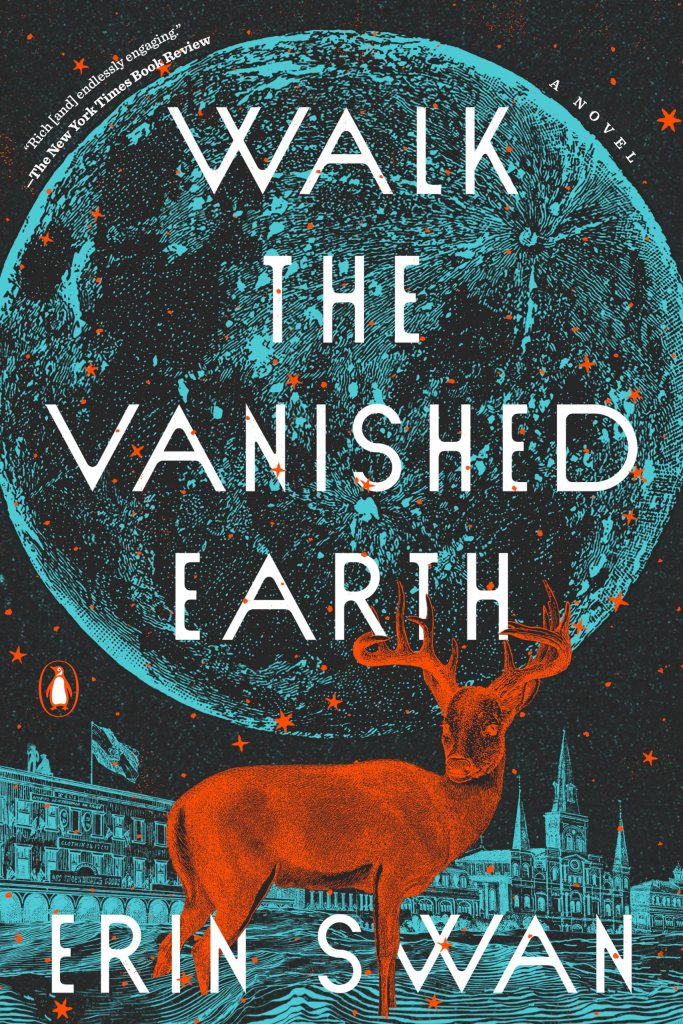
PREMISE: The year is 1873, and a bison hunter named Samson travels the Kansas plains, full of hope for his new country. The year is 1975, and an adolescent girl named Bea walks those very same plains; pregnant, mute, and raised in extreme seclusion, she lands in an institution, where a well-meaning psychiatrist struggles to decipher the pictures she draws of her past. The year is 2027 and, after a series of devastating storms, a tenacious engineer named Paul has left behind his banal suburban existence to build a floating city above the drowned streets that were once New Orleans. There with his poet daughter he rules over a society of dreamers and vagabonds who salvage vintage dresses, ferment rotgut wine out of fruit, paint murals on the ceiling of the Superdome, and try to write the story of their existence. The year is 2073, and Moon has heard only stories of the blue planet–Earth, as they once called it, now succumbed entirely to water. Now that Moon has come of age, she could become a mother if she wanted to-if only she understood what a mother is. Alone on Mars with her two alien uncles, she must decide whether to continue her family line and repopulate humanity on a new planet.
I absolutely loved this book. So much so, that it’s made it into my Hall of Fame. But before I get to why and spurt a load of superlatives to back it up, let’s hold hands and have a quick skip through the Goodreads 1-starrers’ garden. Some corkers for this one:
Torza couldn’t be arsed to finish the book but wanted to add a one-star review anyway, and said, “didnt finish it. idk, maybe it was good, but the multiple child pregnancies was kinda putting me off.” There was one and it was fairly important to the plot. Colleen Carroll (4 lots of double letters in that name…lazy-ass parents…there’s plenty of other letters out there) continued with the ‘let’s make up some bullshit about this book’ by referencing the “obvious/probable forced alien impregnation of a 14 year old”, which didn’t happen. At all. Anywhere in the book. Two reviewers mentioned the term ‘TERF’, suggesting that the author, Erin Swan has an issue with transgender people. Where the fuck they got this from I’ve no idea as there are no transgender characters in the book. Unless that was their problem, in which case they can fuck right off. Why does every author who doesn’t include a trans character get accused of being anti-transgender? For fuck sake.
My favourite review, however, was this baby by Coastalshelf (obviously has an even more embarrassing name than my middle one): “Found the focus on women as vessels for childbirth extremely off-putting”. Ho-lee-shit. This is a book that spreads across centuries and features characters that are related to each other. The only way for that to happen is for women to give birth. That’s not my opinion, that’s just a fact. You know, Coastalshelf, like your mother did to bring you into the world. Women ARE vessels for childbirth, thankfully. Otherwise none of us would be here. Coastalshelf, you’re a fucking moron.
This book is staggeringly good. Absolutely beautifully written, a complex, inter-weaving story with a gargantuan scope. And this is the author’s first book. Mind-blowing…
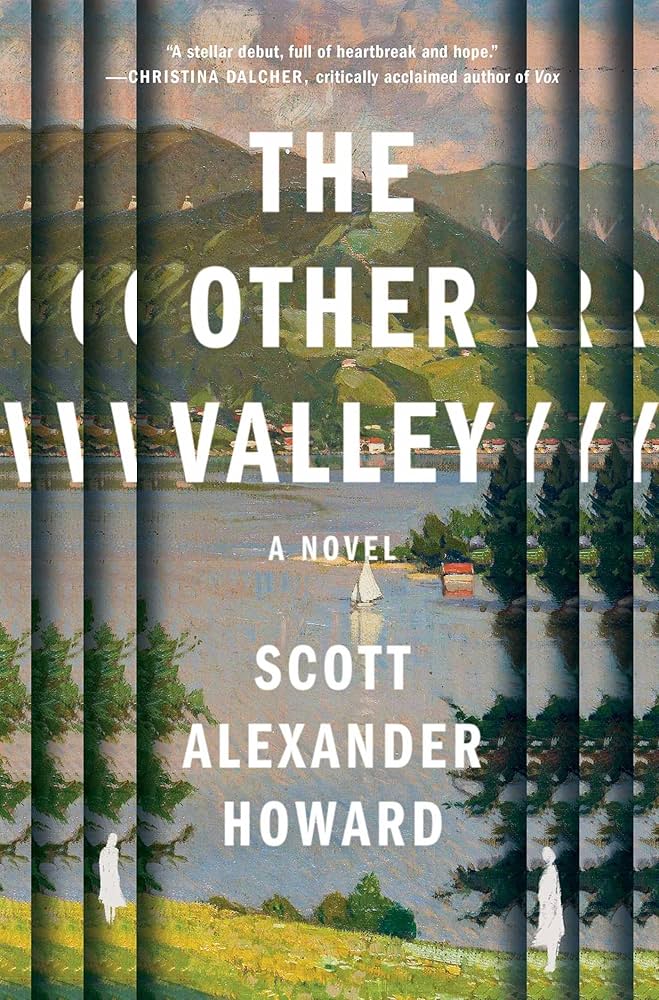
PREMISE: Sixteen-year-old Odile is an awkward, quiet girl vying for a coveted seat on the Conseil. If she earns the position, she’ll decide who may cross her town’s heavily guarded borders. On the other side, it’s the same valley, the same town–except to the east, the town is twenty years ahead in time. To the west, it’s twenty years behind. The towns repeat in an endless sequence across the wilderness.
When Odile recognizes two visitors she wasn’t supposed to see, she realizes that the parents of her friend Edme have been escorted across the border from the future, on a mourning tour, to view their son while he’s still alive in Odile’s present. Edme –– who is brilliant, funny, and the only person to truly see Odile –– is about to die. Sworn to secrecy in order to preserve the timeline, Odile now becomes the Conseil’s top candidate, yet she finds herself drawing closer to the doomed boy, imperiling her entire future..
Yesss. Re-read that first paragraph above – a town that repeats across endless valleys in 20-year gaps. What’s not to like about that idea? Books like this hit my g-spot. If you Google it, someone somewhere will call this type of novel ‘speculative fiction’, although I’m pretty sure the definition of ‘fiction’ is that it’s speculative, otherwise it would be fact. But I get the pigeon-holing and actually I’m grateful for it as it allows me to Google ‘speculative fiction’ and discover books like this. What’s even better about this one is that there’s a really beautiful story being told within the construct of the valleys and the time difference. A great book to get lost in.
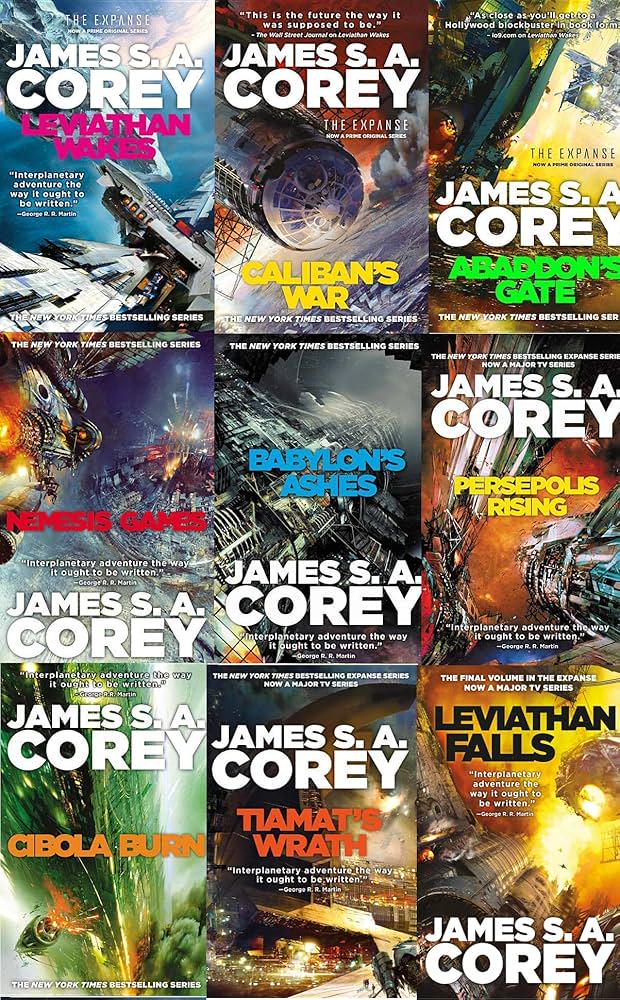
PREMISE: The Expanse primarily tells the story of the crew of the gunship Rocinante over more than four decades as they navigate criminal plots, solar-galactic politics, wars, and an alien mystery. The book series is made up of nine novels and nine novellas.
Man, I love sci-fi. And yet, relatively speaking, I hardly read any at all. It’s a strange paradox which could easily be dramatised in a sci-fi book or film. The Sci-fi Paradox, it shall be called. One man, alone in the blogging universe with only a handful of readers to hear him, wants to read more sci-fi books but never does, and he just can’t figure out why. It’s got instant bestseller written all over it.
I’ve read some Peter Hamilton and quite a few Iain M Banks and a few other sci-fi books here and there but nothing has comes close to The Expanse books for me. They are pitched absolutely perfectly in terms of story and characters and then all the spacey tech stuff to keep the geeks happy. The good guys and gals are all so likeable, the bad ones absolute bellends. There’s alieny creatures and gore, fast spaceships with big guns, interesting and colourful and dangerous worlds and mind-blowing extraterrestrial entities. These books literally have everything and – most importantly – have a cracking story that runs through all 9 books and within the novellas and finishes just as good as it started.
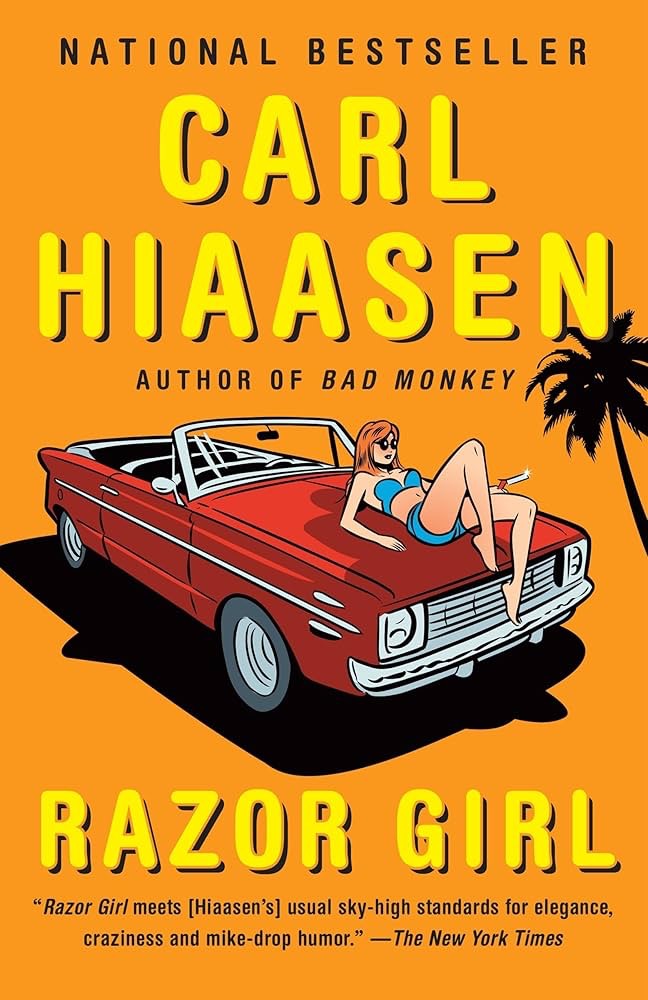
PREMISE: When jumped-up reality TV star Buck Nance aggravates the crowd in a Key West bar, he incites a riot and vanishes in the melee. His hapless agent Lane Coolman should have been by Buck’s side, but has been accidentally taken hostage by two petty criminals who now think they can turn a quick profit by ransoming an LA talent agent.
As the search for Buck continues, the mystery draws in a broad cast of characters from across the island including Andrew Yancy, the disgraced cop who now works restaurants on roach patrol; a delusional fan of Buck’s show; the local sheriff who’s desperate for re-election; a shady lawyer and his gold-digging fiancée; the gay mayor and his restauranteur partner; a Mafioso hotelier; and a redheaded con artist named Merry who, using a razor blade and a high-speed car, has developed a signature way of luring in her victims.
I feel like I’m starting to judge these forays into the Goodreads 1-starrers pretty well now. Surely no one can have a bad word to say about this baby? But yes…yes they can.
Kristin got to 70% before calling it quits. You’re so close Kristin and have come such a long way. I get quitting a book early because it’s just not working but why read 70% of a book you clearly hated?
Vio commented “I’m so tired of florida man humor”. Can’t help but think Carl Hiaasen is bearing the brunt of Vio’s failed Floridian relationships here. Hey Vio, it’s not Carl’s fault…
Liz gave us the cryptic, anti-American “Too American, too brash, too strange compared to my life. And it wasn’t”. And it wasn’t what? Don’t leave us hanging Liz.
Clare minced no words at all by simply stating “hate.”. No capital H but a full stop. Curious grammar.
My favourite though is from Sandy, with the insightful “Written by a man, edited by a man…obviously knows zero about shaving pubs” (sic). I don’t even know where to start with this one but if you’re going to knock the editorial work then at least get your own right.
I love Carl Hiaasen’s books and, in particular, his sense of humour. He is one funny man and I laughed out loud so much throughout this novel (as I do with all his books). Hilarious, sharp, stupid, entertaining, very easy to read. What’s not to like?
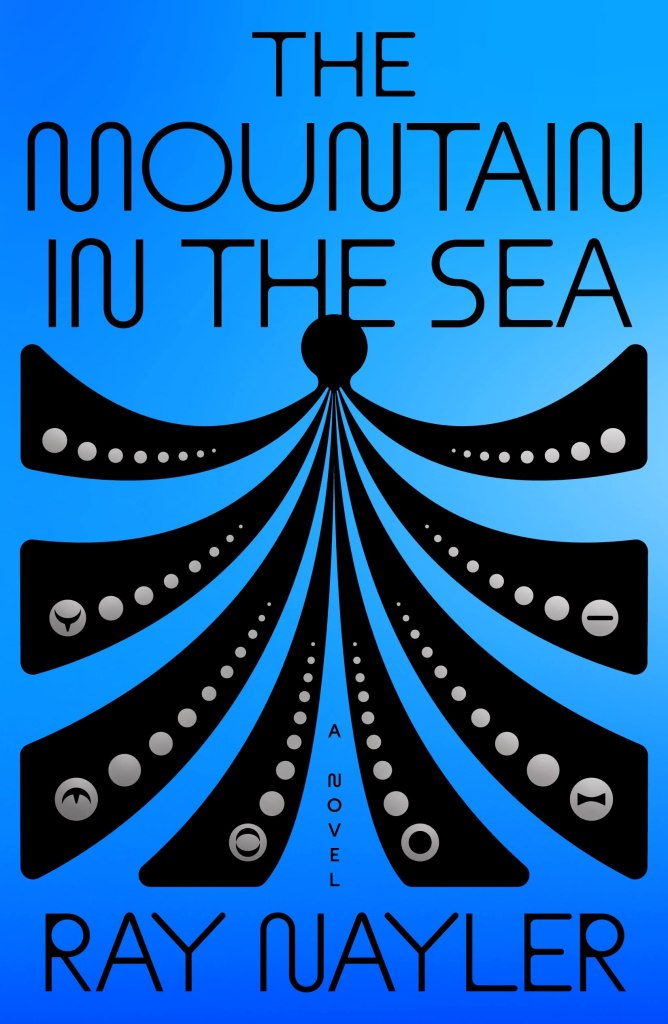
PREMISE: Rumors begin to spread of a species of hyperintelligent, dangerous octopus that may have developed its own language and culture. Marine biologist Dr. Ha Nguyen, who has spent her life researching cephalopod intelligence, will do anything for the chance to study them.
The transnational tech corporation DIANIMA has sealed the remote Con Dao Archipelago, where the octopuses were discovered, off from the world. Dr. Nguyen joins DIANIMA’s team on the islands: a battle-scarred security agent and the world’s first android.
The octopuses hold the key to unprecedented breakthroughs in extrahuman intelligence. The stakes are high: there are vast fortunes to be made by whoever can take advantage of the octopuses’ advancements, and as Dr. Nguyen struggles to communicate with the newly discovered species, forces larger than DIANIMA close in to seize the octopuses for themselves.
But no one has yet asked the octopuses what they think. And what they might do about it.
My 20-year old self was a bit of a twat. In fact, probably anything from 10 or 11 onwards up until well into my thirties (some may argue a lot later) I would proffer I was a bit of a dick. Not that I exactly have life figured out now – absolutely far from it – but aside from my daughter, a few life events and time spent with my now-fiancee, there’s no rose-tinted spectacles when I reminisce. And that extended to my reading habits. I was very narrow-minded in terms of stuff I’d read. Unlike now where I actively search out new authors and stories and love finding something different, back then I’d read the same sort of thing by the same sort of authors. I reckon if someone had read the above premise to me and suggested I read it I’d have rolled around laughing. Like I said, bit of a twat.
So, whilst I’m sure I have a lot of twat left in me, I like to think I’ve broadened a few things in terms of my reading and that’s allowed me to find beauties like The Mountain in the Sea. In many ways, it reminded me of a Richard Powers book; intelligent, thought-provoking, fantastic ideas, so massively enjoyable. I’m not the sharpest tool in the box so any book where I’m learning while I’m enjoying a story is a literary perfect storm to me.
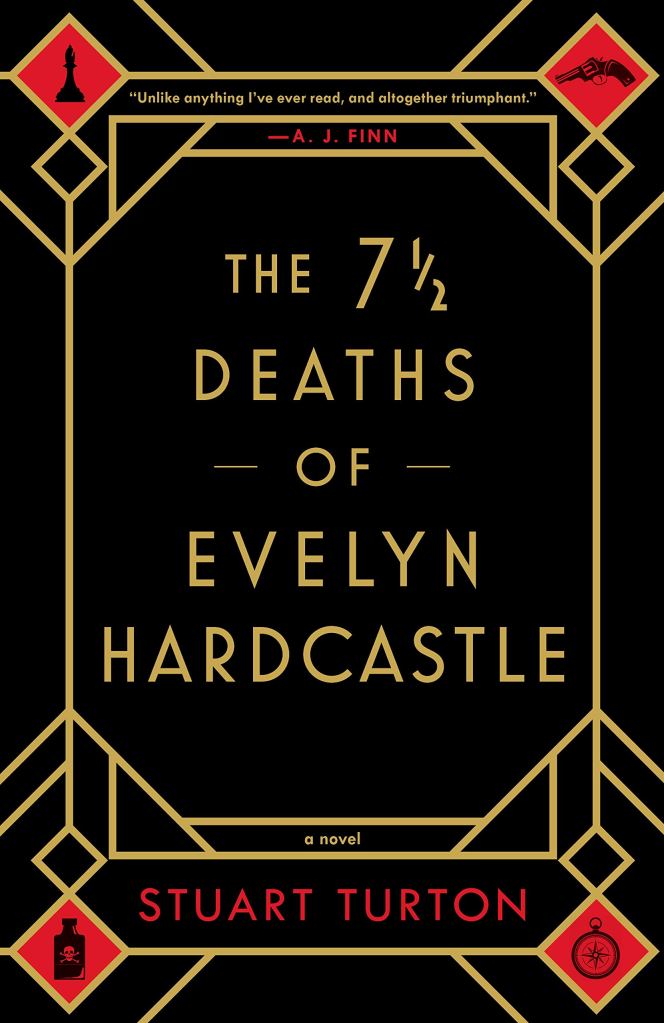
PREMISE: Evelyn Hardcastle will be murdered at 11:00 p.m. There are eight days, and eight witnesses for you to inhabit. We will only let you escape once you tell us the name of the killer. Understood? Then let’s begin . . .
Evelyn Hardcastle will die. Every day until Aiden Bishop can identify her killer and break the cycle. But every time the day begins again, Aiden wakes up in the body of a different guest. And some of his hosts are more helpful than others . . .
Here’s another one. Another book with such a great premise that you wished you’d thought of it yourself. It’s kind of like Groundhog Day meets Quantum Leap meets Freaky Friday meets Miss Marple. What a film that would be. And what a book this is. I read somewhere that it took Stuart Turton three months to plan out the book on a huge spreadsheet where he detailed every two minutes of every character’s day and their location in the house at each point and when you read the book you can easily understand why he needed to do this.
This is literally a book to get lost in; a book that needs 100% of your attention every time you pick it up as the term ‘labyrinthine plotting’ doesn’t even begin to describe it. The real genius, however, is that Mr. Turton pulls it off with aplomb. Absolutely perfect reading escapism.
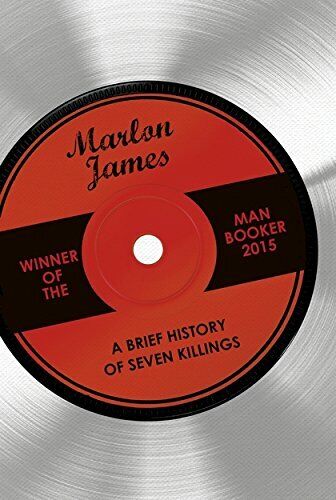
PREMISE: On December 3, 1976, just before the Jamaican general election and two days before Bob Marley was to play the Smile Jamaica Concert, gunmen stormed his house, machine guns blazing. The attack nearly killed the Reggae superstar, his wife, and his manager, and injured several others. Marley would go on to perform at the free concert on December 5, but he left the country the next day, not to return for two years.
Deftly spanning decades and continents and peopled with a wide range of characters—assassins, journalists, drug dealers, and even ghosts—A Brief History of Seven Killings is the fictional exploration of that dangerous and unstable time and its bloody aftermath, from the streets and slums of Kingston in the 70s, to the crack wars in 80s New York, to a radically altered Jamaica in the 90s.
I know I said I’d never write anything negative on here but in my defence, this isn’t about books. And it’s very difficult to sustain a holier-than-thou stance across so many posts before my natural childishly sarcastic tendencies kick in. Anyway, I hate reggae music. Well, hate is a strong word. But if I’m ever jailed at Guantanamo then my captors should eschew Megadeth and Slayer, plop a red, green and yellow bobble hat on my head and torture me with Jimmy Cliff and Aswad. I’d turn snitch and spill the beans on everyone.
What I do like, however, is a fictional story based around factual events and containing real-life characters (see American Tabloid for the ultimate example of this). Particularly when there’s an air of the unknown around the specific details. I love the speculative aspect of it. The ‘this-could-easily-be-the-truth-you-know’ of it. The idea that you’re somehow learning something additional about a piece of history, whether it’s ultimately true or not.
This book, very much like American Tabloid, is pretty mind-blowing in terms of its scope and ambition and what it ultimately achieves. It’s the sort of book that leaves you so grateful that people as smart and eloquent as Marlon James are out there and devote so much of their time to writing something as breathtaking and gargantuan as this.
Oh, and it’s the 2018 Portland Award winner. ‘Nuff said.
PREMISE: January 1937. Clouds of war are gathering over a fogbound London. Twenty-eight year old Jack is poor, lonely, and desperate to change his life, so when he’s offered the chance to join an Arctic expedition, he jumps at it. Spirits are high as the ship leaves Norway: five men and eight huskies, crossing the Barents Sea by the light of the midnight sun. At last they reach the remote, uninhabited bay where they will camp for the next year, Gruhuken, but the Arctic summer is brief. As night returns to claim the land, Jack feels a creeping unease. One by one, his companions are forced to leave. He faces a stark choice: stay or go. Soon he will see the last of the sun, as the polar night engulfs the camp in months of darkness. Soon he will reach the point of no return–when the sea will freeze, making escape impossible. Gruhuken is not uninhabited. Jack is not alone. Something walks there in the dark…
I reckon horror is the toughest genre to write. That is, if you’re writing horror to scare people that is, rather than shock them. Any idiot can write something down that shocks people and nowadays violence is pretty much everywhere so to really shock with brutality and gore you have to go to extreme extremes, but to properly scare (or at the very least, make someone feel uneasy) with words alone is a toughie. Michelle Paver without doubt knows how to do that and, for me, Dark Matter is still her best book. Beautifully written, completely absorbing and is genuinely unsettling throughout.